
The Woman We Almost Missed
On midlife, curiosity, and choosing the less obvious path
Midlife is not supposed to be when you leave everything behind and disappear into the Himalayas. It is not meant to be the moment when you cross forbidden borders or begin again in unfamiliar terrain.
On International Women’s Day, I find myself thinking not about the women whose names we already know, but about the ones who lived at the edges of recognition.
At forty-three, Alexandra David-Néel did precisely what her era did not expect of her.
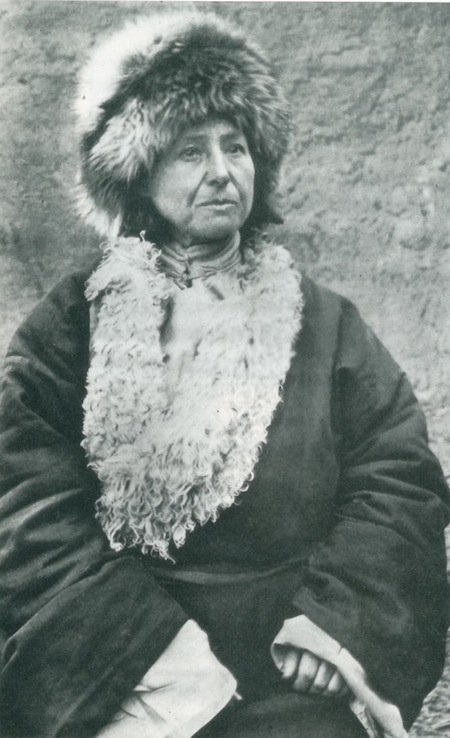
Image: Public domain, via Wikimedia Commons.
I first encountered her while reading Breath by James Nestor. In a chapter describing Tibetan monks generating heat in freezing Himalayan conditions through disciplined breathing and intense concentration, her name appeared almost in passing. I stopped reading and wondered how I had never heard of her, and why she is not spoken about alongside Marie Curie or Joan of Arc, women whose names anchor the history of remarkable lives.
She was born in 1868 into a Europe where women did not vote, rarely travelled independently, and were not expected to pursue intellectual authority beyond narrow confines. Recognition tended to follow men, and exploration was largely considered a male domain.
From an early age, Alexandra resisted containment. Before she became known as an explorer, she was an opera singer, a scholar, and a political thinker with a fiercely independent mind. Restlessness was not a passing trait; it shaped the structure of her life.
In 1911, at forty-three, she left Europe for Asia. What followed were fourteen years of travel across India, Nepal, China, and Tibet. She did not travel as a spectator. She immersed herself fully, learning Tibetan fluently and studying Buddhism not as a fashionable curiosity, but as disciplined intellectual inquiry. She lived in monasteries and spent extended periods in Himalayan caves, committing herself to practices that demanded endurance and psychological resilience.
Among the disciplines she studied was Tummo, often translated as inner fire meditation. This Tibetan practice combines breath regulation, visualisation, and focused attention. Practitioners were known to increase peripheral body temperature significantly in freezing conditions, and decades later scientific studies would document similar physiological effects.
What captivates me is not only the physiology, but the principle beneath it: the ability to generate warmth from within when the external environment is cold and unyielding.
She did not approach these teachings as a distant observer. She tested consciousness directly. In her writings, she described creating what Tibetan tradition calls a tulpa, a thought-form generated through prolonged concentration and visualisation. Whether understood psychologically or mystically, it reveals how seriously she pursued the limits of the mind.
In 1924, at fifty-five, after months crossing harsh terrain, often in secrecy and disguised as a pilgrim, she entered Lhasa, then closed to foreigners. She became the first European woman to do so. This was the early twentieth century, long before commercial flights or global networks supporting solo female travellers. A woman in midlife was expected to consolidate her life rather than widen it, yet she chose otherwise.
Over the course of her life, she wrote more than thirty books and continued travelling well into later years. Exploration was not a chapter she closed; it was how she moved through the world.
At one hundred, she applied to renew her passport, as if another journey still felt entirely plausible. The instinct to learn and to go further had not diminished with age.
What moves me most is not only the scale of her journeys, but the stamina of her curiosity. She did not discard her earlier identities in order to become someone new. Instead, she carried them forward and allowed them to mature. The opera singer, the scholar, the explorer, and the writer were not separate chapters but interconnected expressions of a life that kept unfolding. Her evolution did not require rupture; it required depth.
As I step into my role as a breathwork facilitator after two decades in corporate media, while continuing to study bodywork, the path does not follow a predictable arc. It bends. It widens. It asks for growth rather than repetition.
Today, our mountains look different. They may be career transitions, businesses started in midlife, degrees pursued at fifty, roles left behind after decades of loyalty, or internal shifts that no one else can see yet. The terrain is not the Himalayas, but the inner landscape can feel just as demanding.
I suspect I will be studying all my life, not because I am searching for reinvention, but because curiosity itself feels like a form of aliveness.
Her photograph sits in my study as a reminder that intellectual hunger does not diminish with age, and that choosing the less obvious path is often the most honest response to who you are becoming. History does not always amplify this kind of courage loudly, yet it widens the horizon for the rest of us.
